
Editorial
The global rise of "Korean Cool" is no longer a nascent trend; it is a solidified cultural phenomenon. From cinema and music to digital technology, the world has become accustomed to the vibrant, high-energy output of Korea. However, for those of us within the architectural community, the "Rise of the Korean Cool" has often remained vague and distant — a concept hard to grasp in physical form. This issue on Young Korean Architects (YKAs) acts as a departure point: a threshold from which a new generation of Korean architects are moving beyond mere aesthetic "coolness" toward a profound structural and philosophical maturity.
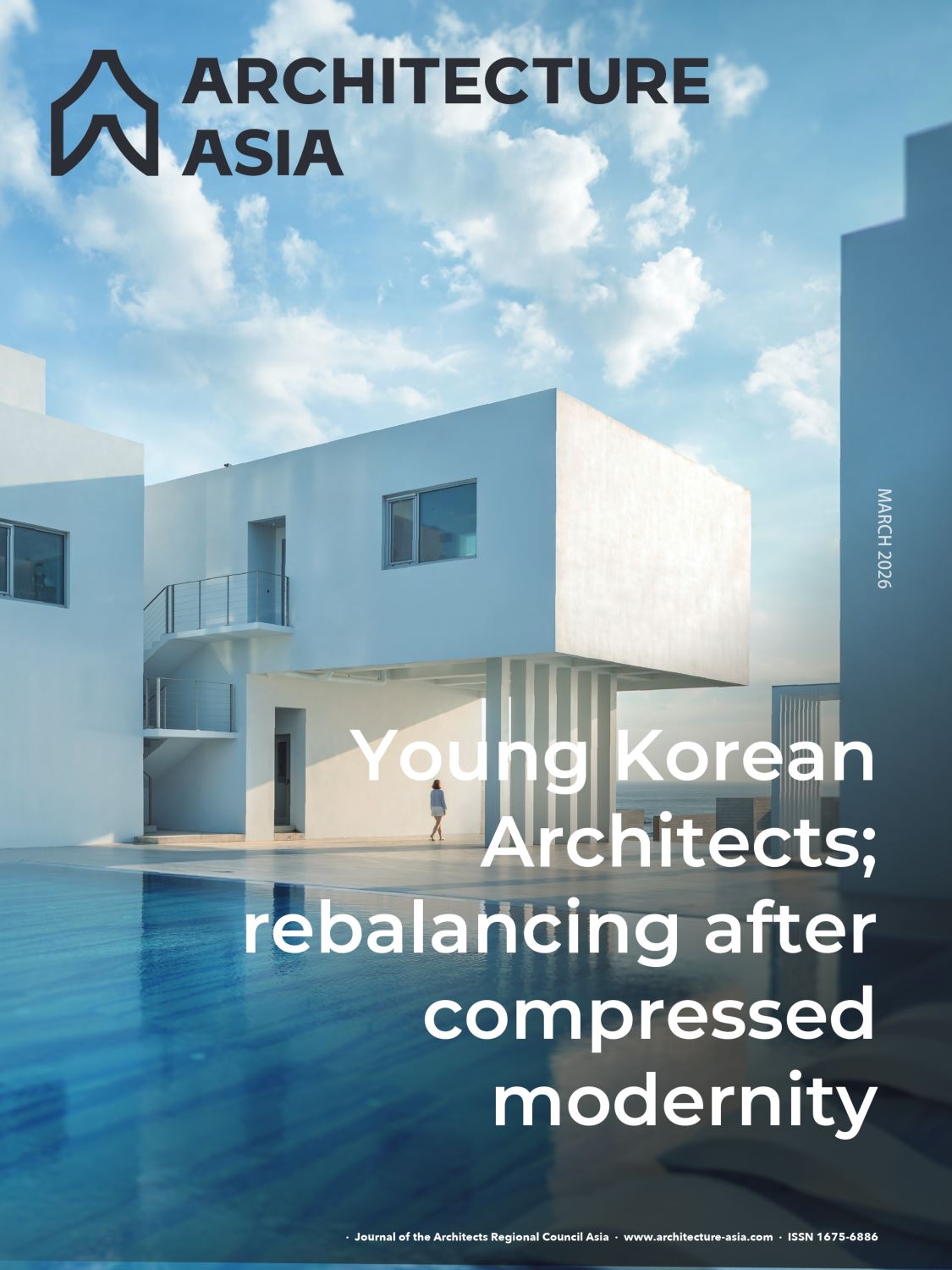
In this special issue of Architecture Asia, we turn our eyes toward seven teams of young Korean architects who are redefining the built environment during this period of global rebalancing. While their predecessors—active during Korea’s “Compressed Modern” era—laid the groundwork for rapid urbanization, this new cohort operates with a different set of priorities. They are the architects of "Rebalancing": harmonizing the local with the global, the traditional with the avant-garde, and the rapid pace of development with the slow, meditative requirements of human-centric design.
The Philosophical Anchor: Harmony Without Uniformity
To understand the current trajectory of Korean architecture, one must look toward the intellectual framework supporting it. This issue is enriched by the insights of Professor Jin Baek, whose in-depth analysis of the seven featured teams provides a necessary academic bridge between theory and practice. His contribution helps illuminate the underlying thread connecting these diverse practices.
Furthermore, a concise yet vital essay by Joung Yun Bahk, editor of KIRA Monthly, explores the similarities and differences among these teams regarding their interpretation of social changes in a post-industrial, stagnant urbanization era. Bahk focuses on how these architects navigate an uncertain future, using their individual design approaches as tools for survival and as a means to discover a unique spatial language.
Architect Gibson Rhie translates the phenomenon of the "Korean Cool" from pop culture and applies it to architecture. By examining the underlying reasons for the sudden outburst of creativity in K-pop and cinema, he suggested that applying a similar logic to architecture—specifically through the relaxation of reviews and regulatory constraints—will foster a more positive and creative change in the Korean built environment.
There is an ancient aesthetic philosophy where Art finds a second life through the hands of the youth. In an era where "more and bigger" was the motto of the economic miracle age (1970s–1990s), the seven teams introduced here demonstrate the power of "enough." Their work suggests that contemporary Korean architecture is finding its voice not through loud, iconic gestures, but through the sophisticated management of space, material, and light. They are mastering the art of being contemporary without losing the "empty space" (bi-um) that defines the Korean spatial identity.
Navigating a Complex Landscape
The teams featured in this issue represent a cross-section of a changing profession, navigating a landscape that is technologically advanced yet environmentally conscious. Through their work, we see a recurring commitment to:
- Urban Porosity: Breaking down the rigid boundaries between private and public spheres in the dense metropolis.
- Material Sincerity: An exploration of how traditional materials can be reinterpreted through robotic fabrication or sustainable re-use.
- Social Connectivity: Architecture that functions as a catalyst for community in an increasingly digital and isolated society.
These architects are not merely building structures; they are crafting the social and cultural infrastructure for a Korea that is post-industrial and hyper-connected. They are the practitioners who will define what it means to be "Korean" in the architectural sense for the mid-21st century. As we present these works to the wider ARCASIA community and beyond, we invite a dialogue. The challenges faced by YKAs—high urban density, the tension between heritage and development, and the quest for sustainability—are shared by architects regionally and internationally. By examining the Korean context, we hope to spark insights that resonate in cities across the world. The "Korean Cool" may have opened the door, but it is the intellectual rigor, the attention to social change, and the philosophical depth of these young architects that will keep that door open. We are witnessing a generation that is not content to simply follow global trends; they are setting a new standard for what a responsive, responsible, and refined Asian architecture can look like. The work of these seven teams is a testament to a future for Korean architecture that is not just "cool," but both local and global.



 loading......