
Author
Red Bean Architects LLP (RBA) is a registered practice with the Board of Architects and the Singapore Institute of Architects, first established as a sole proprietorship in 2009 by Teo Yee Chin. In 2020 Red Bean Architects was converted to an LLP, bringing in Zeeson Teoh as a partner. The practice completed a number of private residential houses and interiors in the frst few years before beginning to diversify their portfolio with more public projects in the civic, educational and institutional domains. They have also built up an expertise in adaptive reuse of existing structures while updating them to accommodate evolving programmatic needs. The practice takes a humble, technical, and deeply contextual approach towards the design of buildings, seeking to understand the wider social, cultural and urban context of each project so as to create strong connections that anchor them in place.
Email: admin@redbeanarch.com
How did the project come about? Why this choice of site, integration into the urban environment or into the landscape? Can you outline the design concept, programme and functional characteristics? What are its Structural and technical characteristics, and also its building services?
Sport Singapore, the state agency in charge of the public sporting facilities, has been going through a renewal and rejuvenation of frst-generation sport centres in Singapore, most of which were built in the seventies and eighties. Delta Sport Centre (Delta), serving the community since 1979, is one of them. Consultants were selected from the panel of public sector consultants, and design work started in late 2017.
There are three pools, one indoor gym, one hockey stadium, and one indoor hall with badminton/multipurpose courts. As a multi-sport complex, the integration of the different uses could be improved. With minimal interventions and creative reuse of structures, the project unites them into a seamless fow of activities that also connects with and engages the surrounding communities.
Occupying a 3.25-hectare site are three key components - the indoor sports hall fronting Alexandra Road, the swimming complex alongside Tiong Bahru Road, and the hockey stadium in between.
In the 1980s, the facilities were considered state of the art. For example, it boasted the frst astroturf and mechanically irrigated pitch. In the late 1980's the rise of the MRT viaduct along Tiong Bahru Road crudely blocked off the relationship between Delta and Redhill estate. With the development of more advanced arenas over the years, the facilities have also transitioned from being national competition venues to becoming exercise spaces for the community, with the courts often overbooked.
The intervention frst links up the venues previously operating separately as an integrated complex using "one active bridge". This is an elevated thoroughfare that extends the overhead bridge crossing Tiong Bahru Road into the complex. Along this promenade, the pedestrian is frst welcomed into the spatial volume with the sheltered teaching pool, then passes through and overlooks the hockey and futsal felds in the middle of the site, before reaching the indoor sports hall at the northern boundary.
Here, facing Alexandra Road, the opaque brickwork of the hall is replaced with full glazing ftted within the existing concrete frame to attract commuters and nearby residents. A tarmac entrance driveway was also paved over and pedestrianized to form a seamless connection for commuters.
Along the eastern boundary, we removed walls and fences for more porosity to welcome residents from Henderson Crescent.
Existing concrete tiered seating for spectators at the hockey pitch and badminton hall, always empty nowadays, gave way to yield a much-in-demand activity space for additional futsal and badminton courts. Balancing above subtractive operations, an elevated box housing a new 1,000sqm ftness gym is the key formal addition, sheltering a teaching pool and looking over the viaduct to gain a presence in Redhill. Concrete sun-shading fns and glass vision panels are integrated in the rippling façade, which echoes the lively waterplay downstairs and evokes the quieter, but no less powerful diagonals in this old landmark.
The interventions do not change the siting of this familiar community space but improve its connectivity and visibility. It remains comfortably nestled within the existing neighbourhood, but now much less hidden and more accessible.
Architecturally
The complex is innovative in its complementary use of additive and subtractive architectural strategies to create a multi-functional sports complex. It shows technical sophistication to work within and retain an old building with complex structural and site constraints. The designers found an opportunity to use strong architectural form impactfully with the elevated gym block, while showing restraint in using subtractive strategies to open up other structures, such as removing walls and slabs to become more welcoming. This works to improve the functionality of the facilities, especially where concrete spectator seats were removed to create more playing courts.
An Urban connection to all that builds on the existing. Being a sprawling site in between disconnected and high-rise residential neighbourhoods that are furthermore catering to different income groups (high-end condominiums and social housing blocks), the opportunity for this sports centre was to be a programmed linkage between different communities. The project is an accessible hub to encourage and facilitate active living. It contains different sports arenas that cater to different levels of activity – from professional to casual, from structured to spontaneous. Complementing these are fexible and multipurpose spaces that invite free play by the public.
As an ecological and economic strategy, the complex retains the majority of the existing structure and makes incisive interventions to improve its functionality and connectivity. The construction is largely cast-in-situ reinforced concrete with painted infll walls of pre-cast panels or brick walls. This matched the existing structures that were retained. Floor surfaces were usage-determined, such as outdoor vinyl for the pool deck, epoxy coating for outdoor ball courts, and timber fooring for indoor ball courts. Larger spans for the sporting spaces were bridged with reinforced concrete beams and roofed with metal deck standing seam roofs. These are inexpensive conventional methods that interface well with the existing structure. The savings on resources are clear, with the construction estimated to cost a third of what an equivalent new complex would demand. Adaptive reuse yields a new yet familiar facility, exciting residents without alienating them. This approach is thus both environmentally and socially sustainable.
The complex relies largely on cross-ventilation in the public circulation passages, taking advantage of Singapore's mild climate. The multipurpose hall and bathrooms are naturally ventilated, supplemented by fans. The ftness gym is the only signifcant air-conditioned space. Here, angled cast-in-situ concrete fns and glazing in between create a jagged envelope whereby the opaque fns are oriented east-west, facing the incident sunlight, while the glazing is always facing north-south to receive light and allow views out. (Note the sun in Singapore comes from the east and west.) This confguration reduces heat gain into the space while creating an interesting and transparent profle for the form.
The facilities are backed by the national agency Sport Singapore that promotes sporting activity for the population. This involves integration with their online management system that allows users to choose, pre-book, and pay for the venues. The facilities are managed by the same agency that attends to public feedback and upkeeps the property to function optimally. These soft structures complement the physical premises, which provide a great variety of activity spaces. Lastly, the courts can be customised to different uses, such as badminton/basketball indoor halls and hockey/futsal/pickleball outdoor courts. These spaces can furthermore adapt to new sports which may become popular in the future. Non-physical aspects of healthy living are integrated with the Active Health Lab in the complex, which gives basic health monitoring and advice to the public, such as regarding heart rate and blood pressure.
The complex deserves recognition for its adaptive reuse of structures that forges new relationships to the transport infrastructures that have evolved over time, while improving long-standing bonds to the communities around. The sprawling site interfaces neighbourhoods and transport networks on different fronts, and serves as an effective in-between, allowing pedestrians to criss-cross the site for better connectivity. Existing structures were also familiar to the residents, and modifying them for continuity holds great emotional value for them. This approach is environmentally and socially sustainable because it achieves cost-effciency and reduces resource usage while extending the lifespan of a well-loved community hub.
On the urban scale, the centre is accessible by the mass rapid transit (MRT) system as well as the bus network. It is also accessible via two main motorways, Alexandra Road on the north and Tiong Bahru Road on the south. The centre plugs into this public transport infrastructure by providing 96 bicycle parking spaces. For motorcar users, seventy carparking, fve motorcycle, and two accessible parking spaces are provided. The main vehicular drop-off roundabout is next to the swimming pool complex, and a service centre is clearly visible thirty meters away from this point, where there are staff to assist with any queries.
There are multiple entry points to the complex on the south, north, and eastern edges, with direct entry into the second storey also possible through the overhead bridge across Tiong Bahru Road.
The complex has one elevator, which is located at the swimming complex area that is also directly below the ftness gym. The complex is not secured at the boundaries – in fact, fences have been removed so that pedestrians can flter in freely. Entry into facilities that require payment, such as the pools and ftness gym, is accessed at the facility itself with turnstiles that scan the user's identifcation and charge by cashless methods, while ball courts are pre-booked with an online system.
A visual signage system is installed throughout the complex, with the overall map displayed at the drop-off point and lift lobbies. The complex is broken into three key programmatic components – Swimming Complex, Hockey Stadium, and Indoor Hall, and abbreviated as SC, HS, and IH for easy orientation. Tactile tiles on the ground guide the visually impaired through the main circulation corridors, and braille labels are installed on the handrail at the beginning of the staircases. Ramps with handrails and tactile tiles are provided between all level changes. An accessible ramp is provided for entry into the teaching pool, which is 1 metre deep and allows the elderly to stand and partake in group ftness activities. There are two accessible toilets provided at the indoor hall and four provided at the swimming pool complex, one of which serves the third-storey ftness gym. All toilets are provided with strobe lights that warn of emergencies to the hearing-impaired. Correspondingly, a public address system is installed across the complex for key announcements.
In terms of materials, the pedestrian passageways use an epoxy coating system over concrete foors, providing good grip and durability. The textured outdoor vinyl used is an innovation for outdoor pool decks, replacing the existing ceramic tiles. It is elastic and does not crack, is not hot to walk on under the sun, is a bit softer to the touch, and has a good grip to prevent slipping even when wet.
The complex brings people of different physical abilities together through sport. It does so through its facilities as well as connectivity across the complex. Of note is the accessible teaching pool, which incorporates a gentle ramp to enter and exit the pool. The complex also prioritises pedestrian connectivity to the surroundings and its various facilities. It does so through the use of a seamless thoroughfare on the second storey that cleverly integrates levels of the overhead bridge across Tiong Bahru Road and structural levels of the existing complex. The strategic elevator placement near the thoroughfare facilitates vertical access across levels.
Figures

Tiong Bahru Road View: As a community space in a residential neighborhood, the new Delta Sport Centre is a horizontal counterpoint to the agglomeration of surrounding towers, 2023.(Finbarr Fallon)
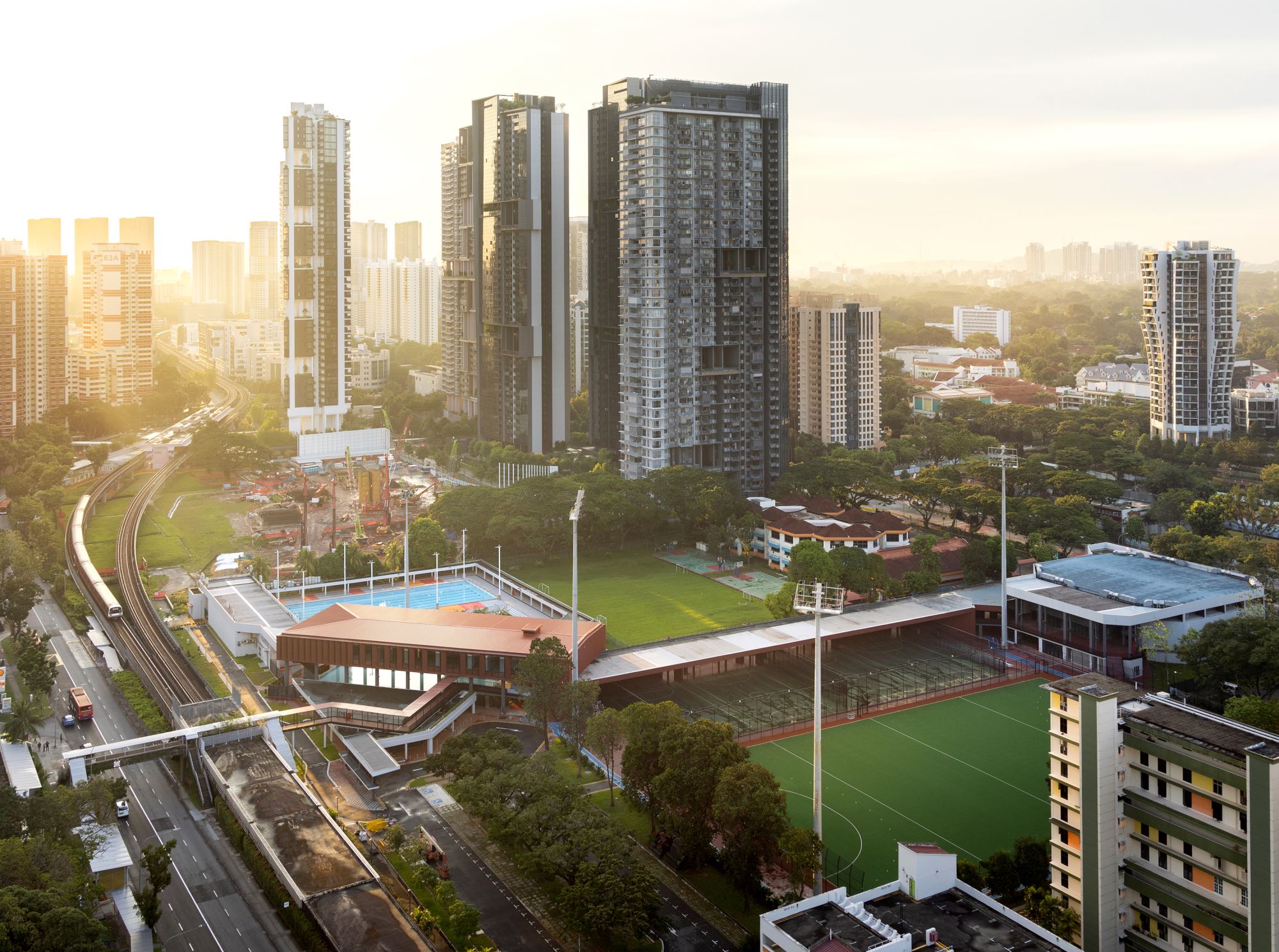
Overview: The project site is vast but materializes as an urban connector between the diferent neighborhoods surrounding it. We conceive it as "one active bridge" linking north to south, from the old HDB estate of Tiong Bahru Road to the condominium belt of Alexandra Road, 2023.(Finbarr Fallon)
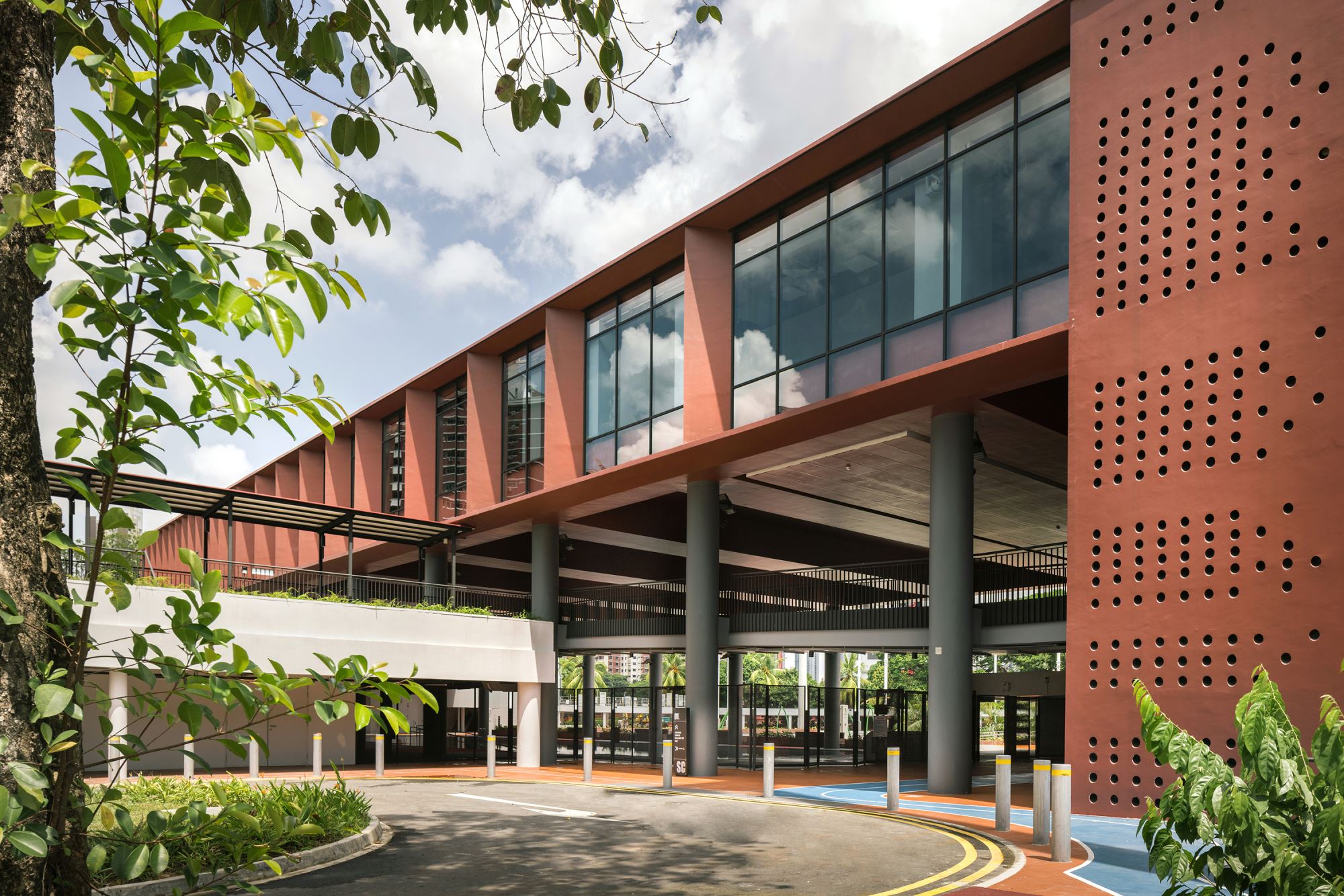
Drop Of Point: The main entrance and drop-of is framed by the gym block. Small circular perforations in the concrete staircase wall provide natural ventilation without use of aluminium and glass, 2023.(Finbarr Fallon)
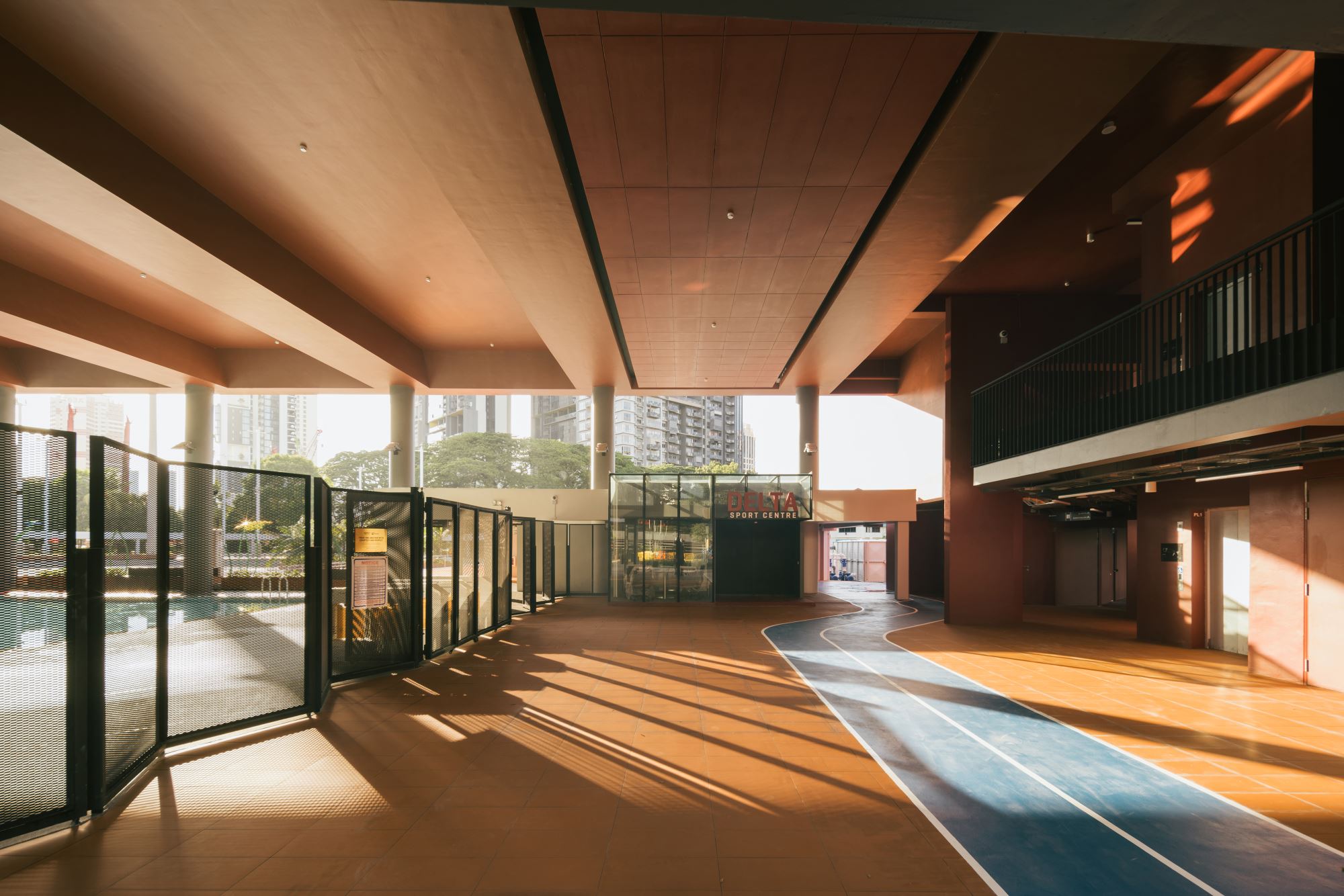
Entrance Reception: The elevated gym block not only shelters a teaching pool but also the approach to the entrance reception. If accessing via the overhead bridge from Tiong Bahru Road, the second-storey promenade also meanders through this double-volume space, 2023.(Finbarr Fallon)
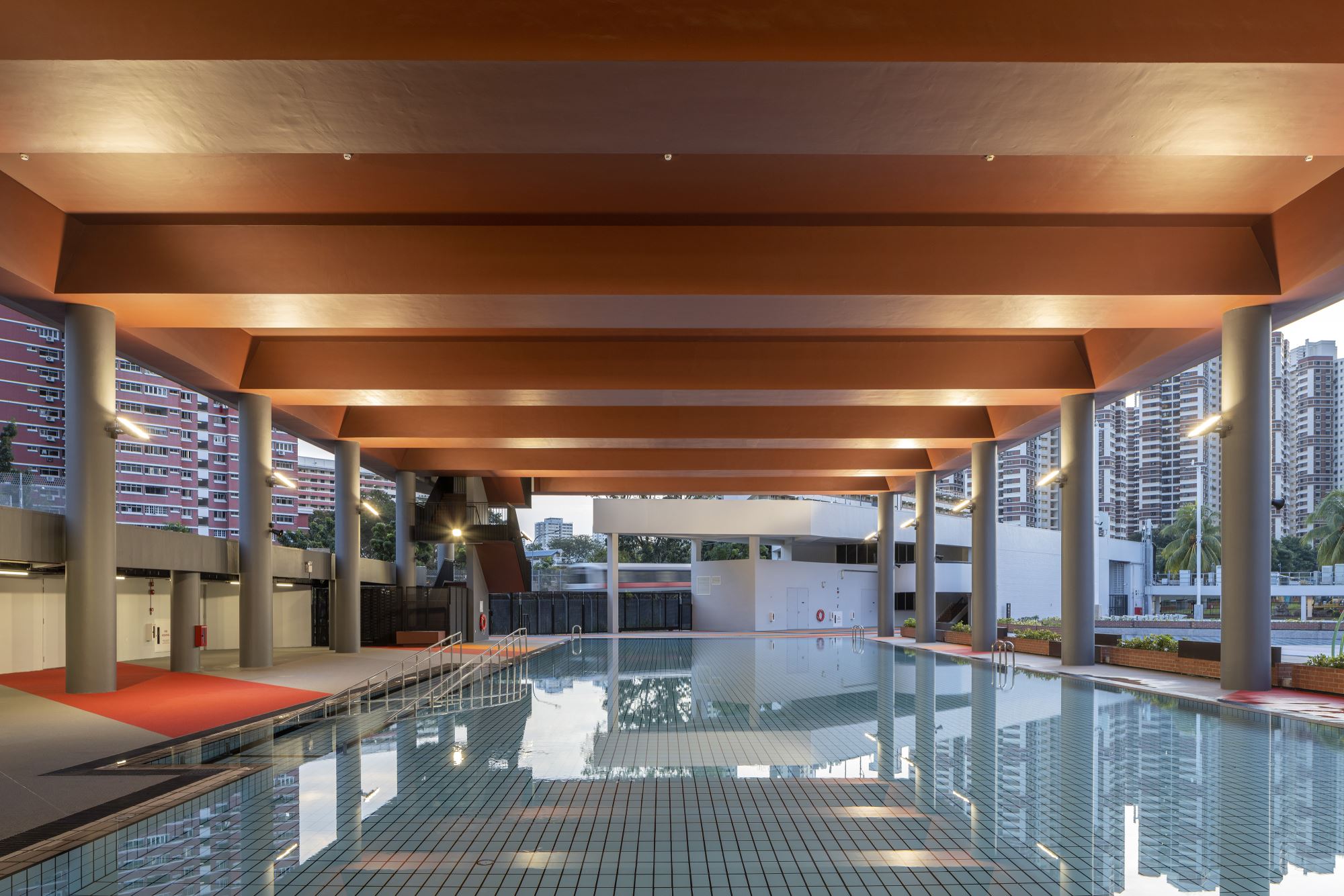
Sheltered Teaching Pool: The sheltered teaching pool retains a visceral connection to the context when the train zooms past every few minutes at eye level, an experience of the MRT that surely cannot be had anywhere else, 2023.(Darren Soh)
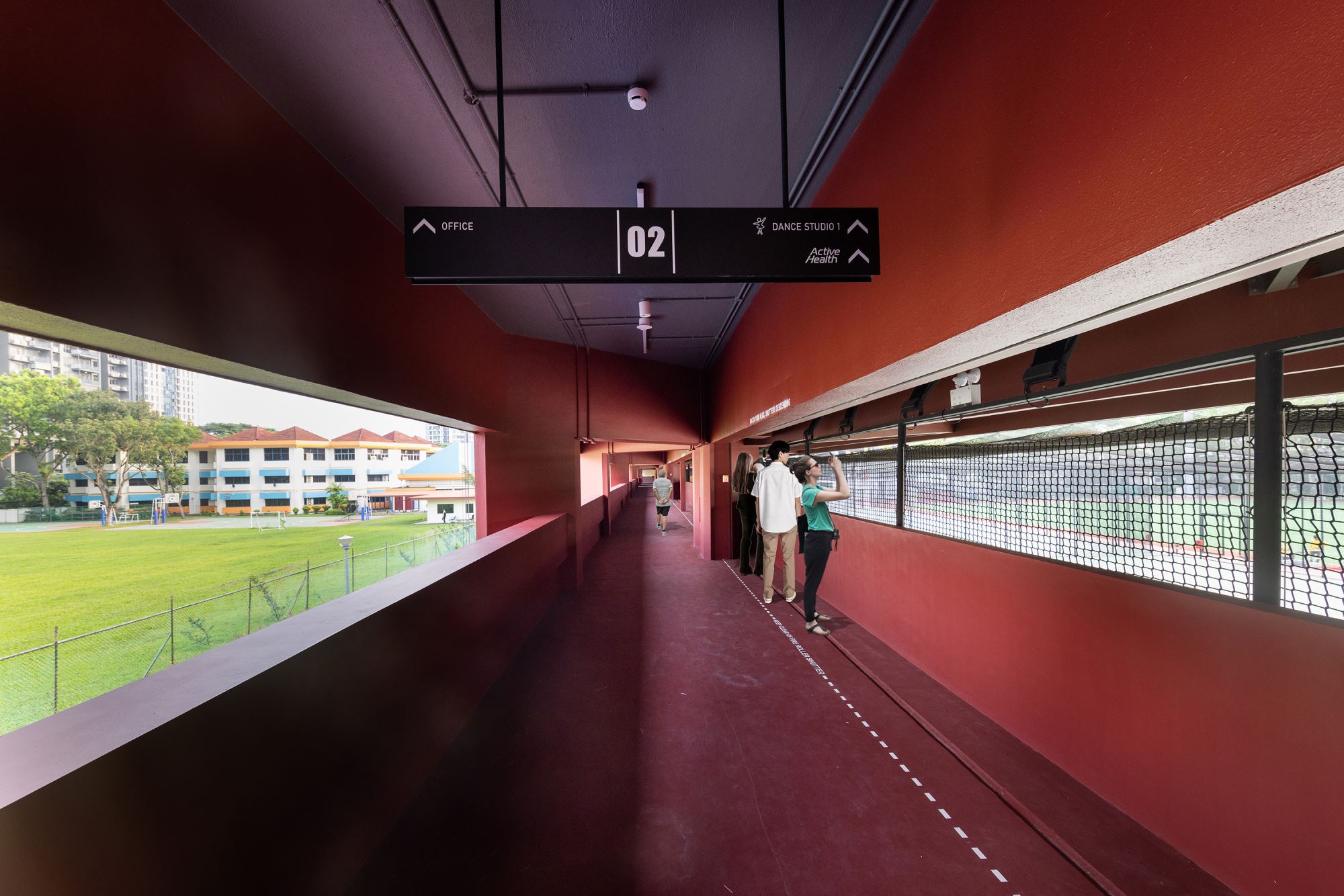
Elevated Promenade: What used to be the top step of the concrete stadium seating is now re-imagined as an elevated promenade that connects the swimming complex to the indoor hall, while overlooking the new futsal and hockey courts downstairs, 2023.(Finbarr Fallon)
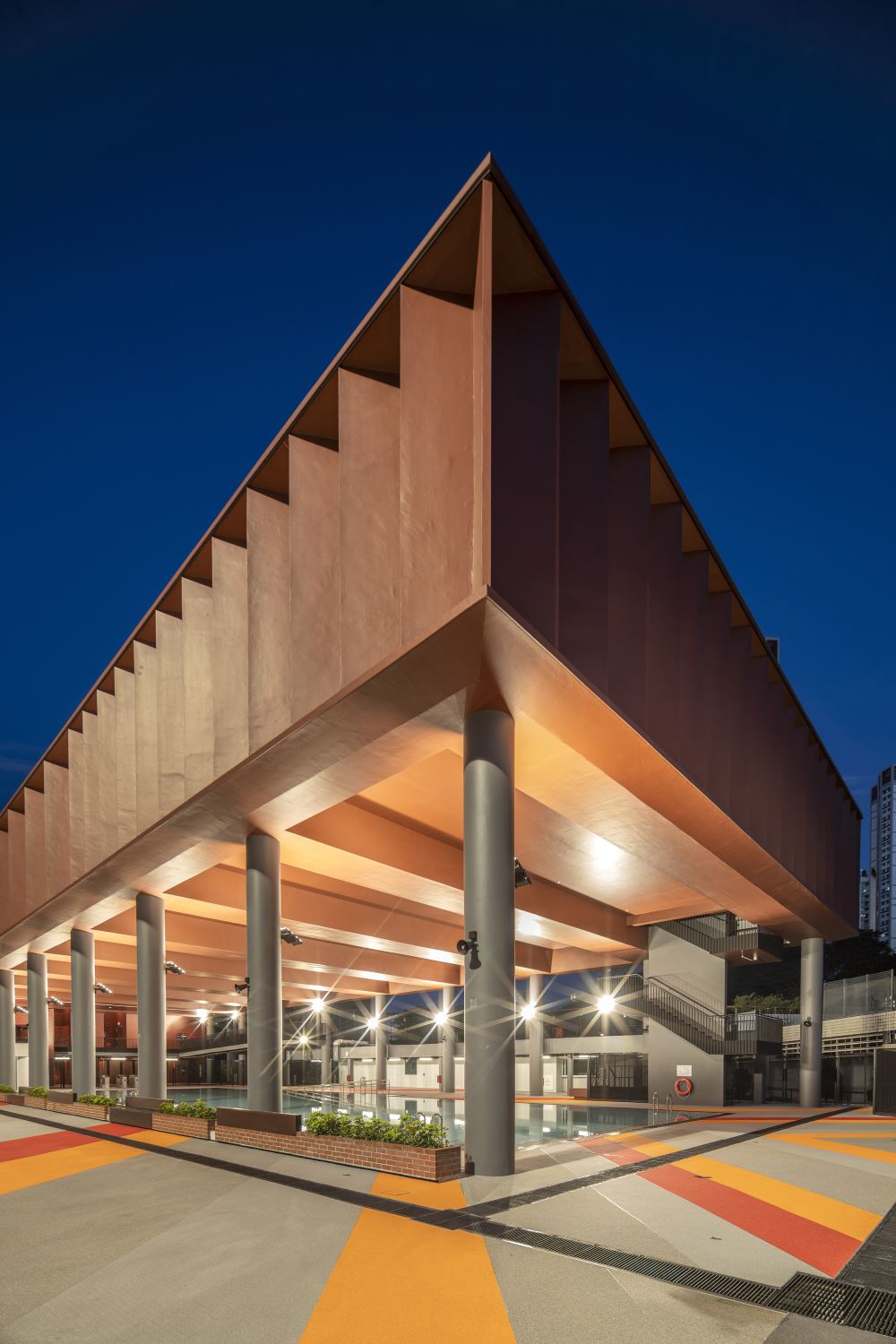
Gym Block Facade: The gym block façade integrates sun-shading concrete fins against the east and west sun with glazing always facing north and south. The solitary fin touching the corner is a result of this logic, 2023.(Darren Soh)
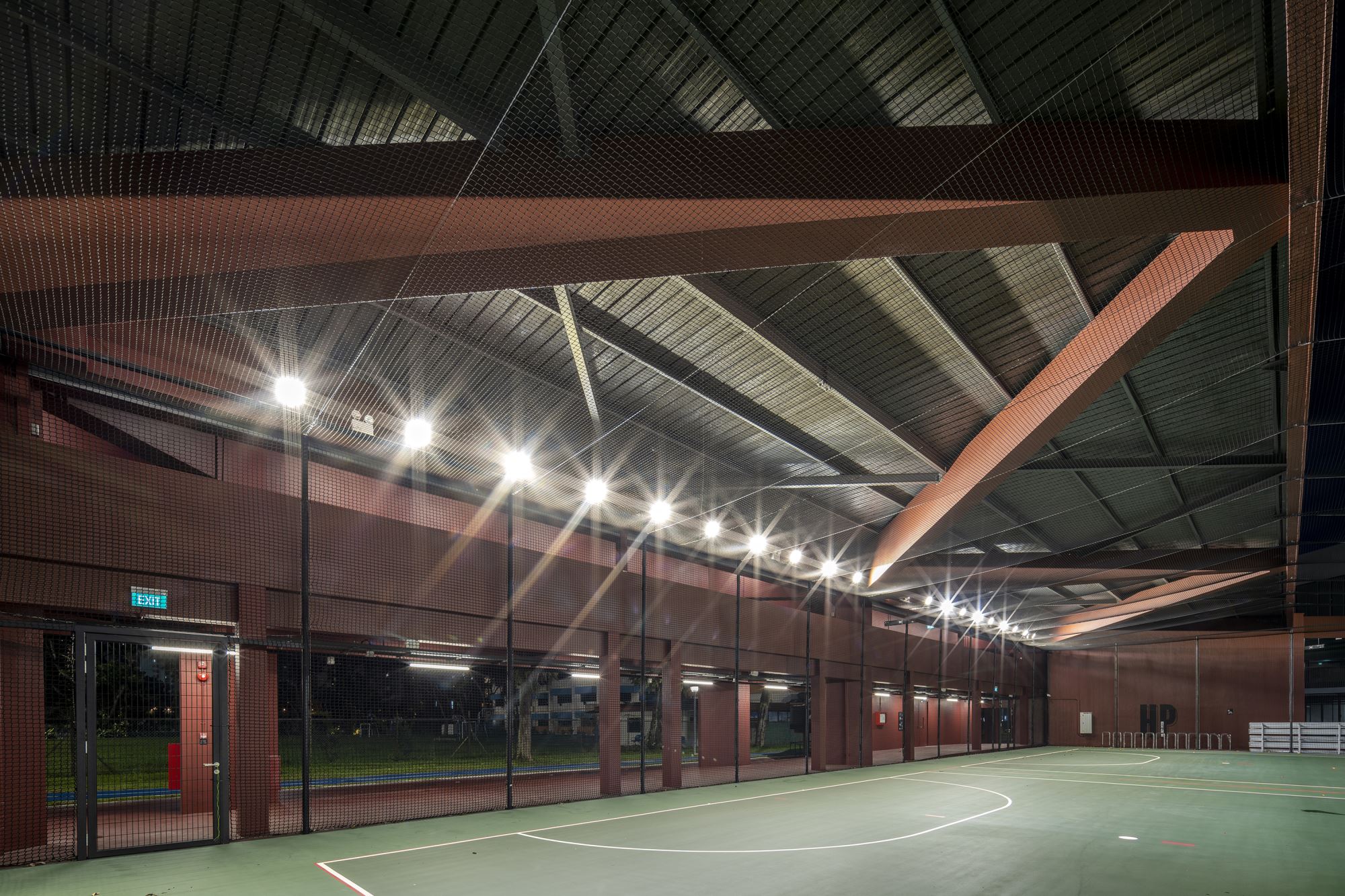
Multipurpose Court: The zig-zagging cantilever beams and canopy are retained from the existing stadium architecture while the concrete tiered seating were removed to provide space for new futsal courts, surely the scene of exciting action in the evenings to come, 2023.(Darren Soh)
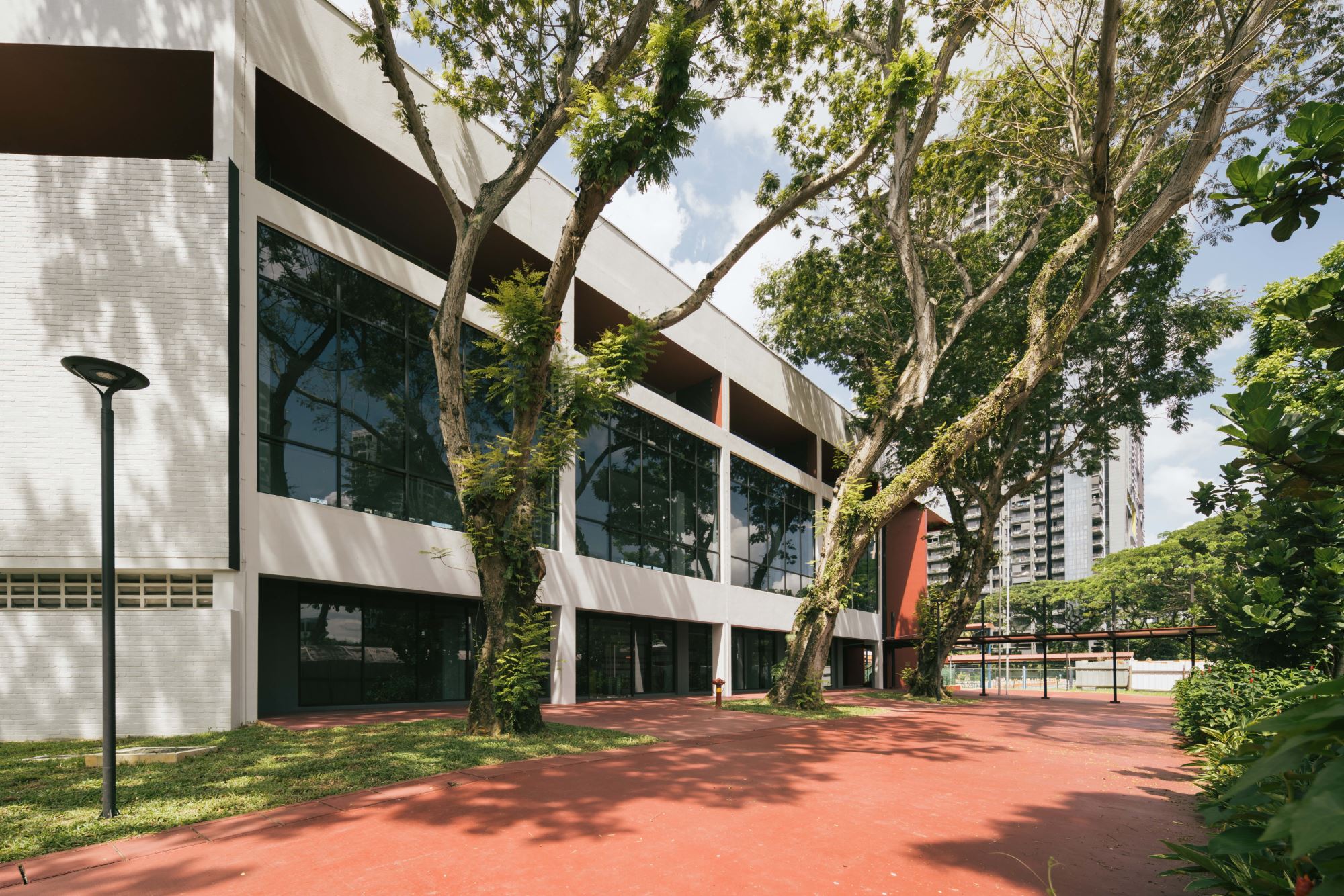
Indoor Hall: The previously opaque façade was opened up with full height glazing replacing the brick infill within existing reinforced concrete frame. The former driveway and parking in front of this were also paved over to form a traffic-free connection from bus-stop to the indoor hall. Mature trees here were retained to provide shade and character, 2023.(Finbarr Fallon)
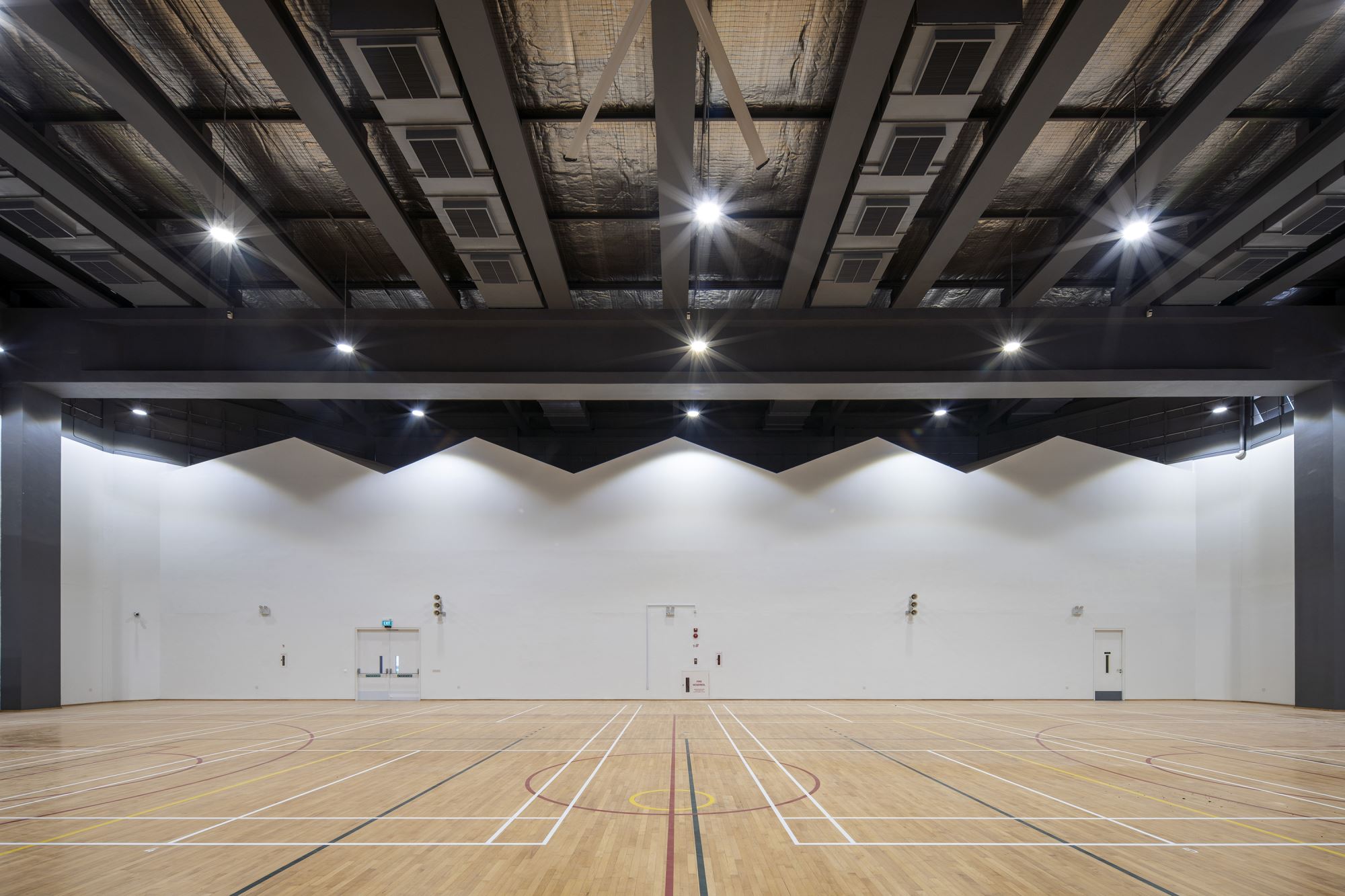
Indoor Hall: The indoor hall is used mostly for badminton games. We retained much of the hall but converted the stepped seating on the far side to provide space for 2 more badminton courts, a dance studio, and a café, 2023.(Darren Soh)
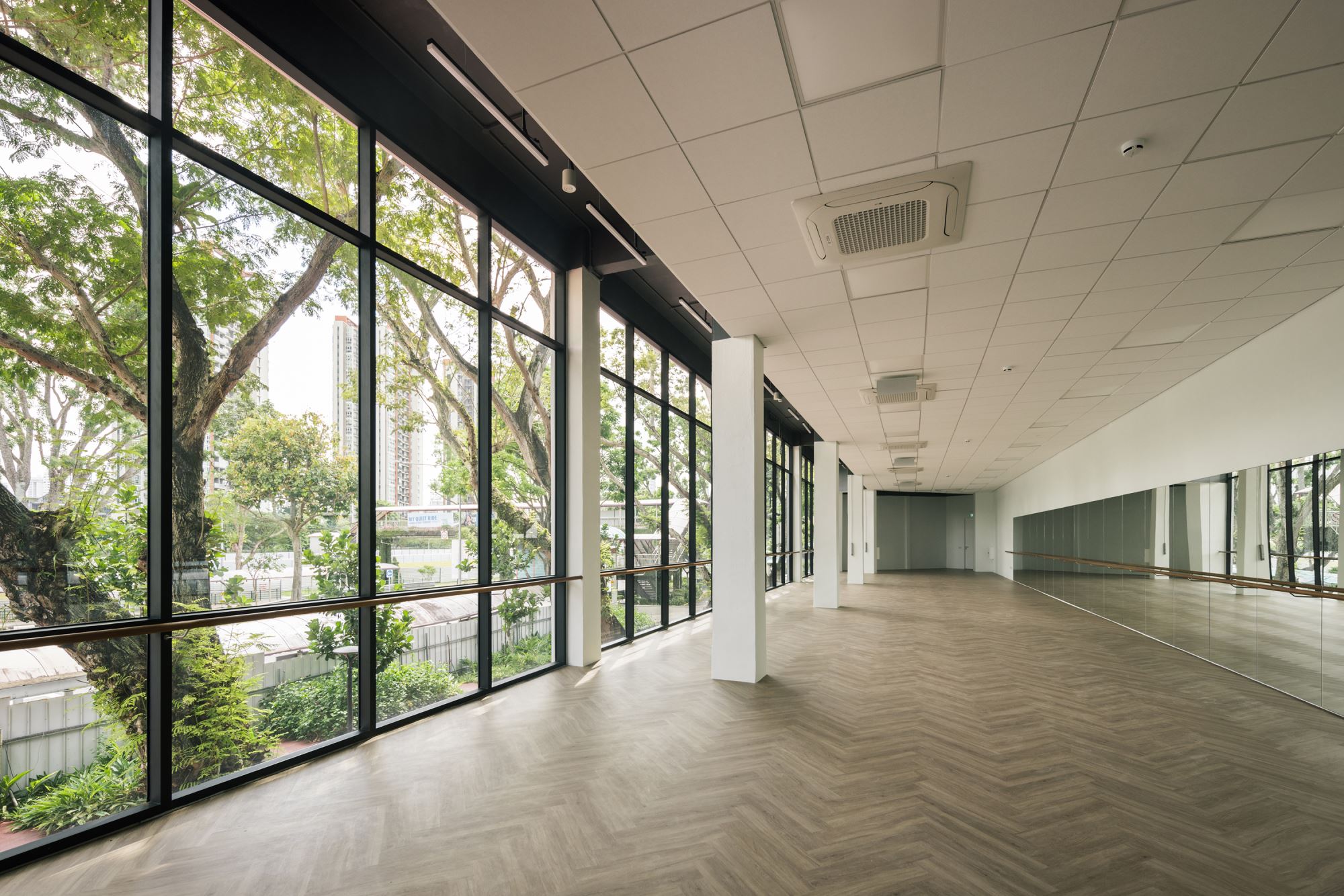
Indoor Hall: The previously opaque façade was opened up with full height glazing replacing the brick infill within existing reinforced concrete frame. The former driveway and parking in front of this were also paved over to form a traffic-free connection from bus-stop to the indoor hall. Mature trees here were retained to provide shade and character, 2023.(Finbarr Fallon)

Indoor Hall: The indoor hall is used mostly for badminton games. We retained much of the hall but converted the stepped seating on the far side to provide space for 2 more badminton courts, a dance studio, and a café, 2023.(Darren Soh)
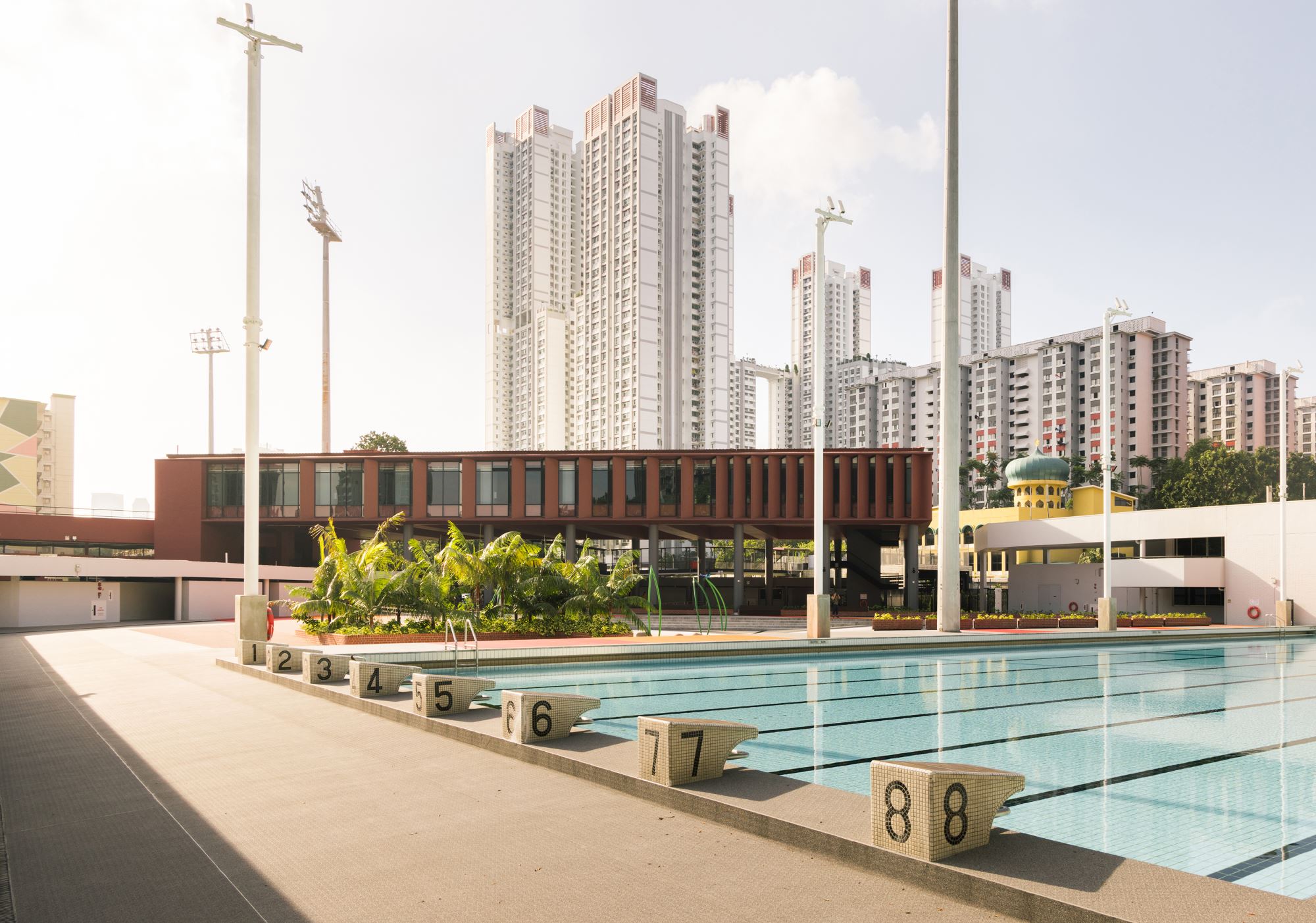
Swimming Pool Complex: An addition and alteration project should always be understood as adaptive re-use. This includes preservation of existing elements, selective removal of parts, and the insertion of new form where needed, 2023.(Finbarr Fallon)
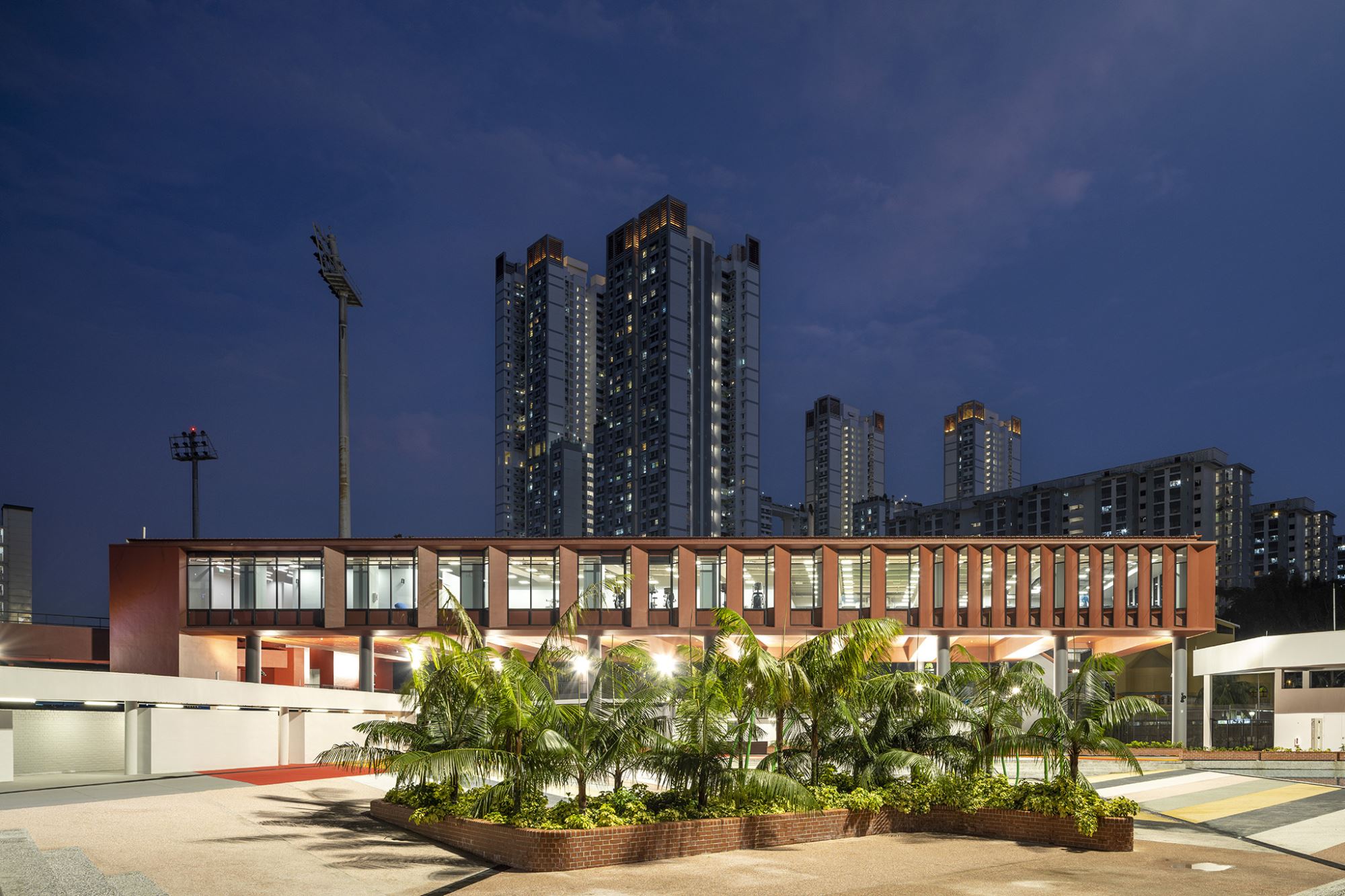
Swimming Pool Complex Night View: Night view of the elevated gym block against the backdrop of Redhill's HDB blocks, 2023.(Darren Soh)
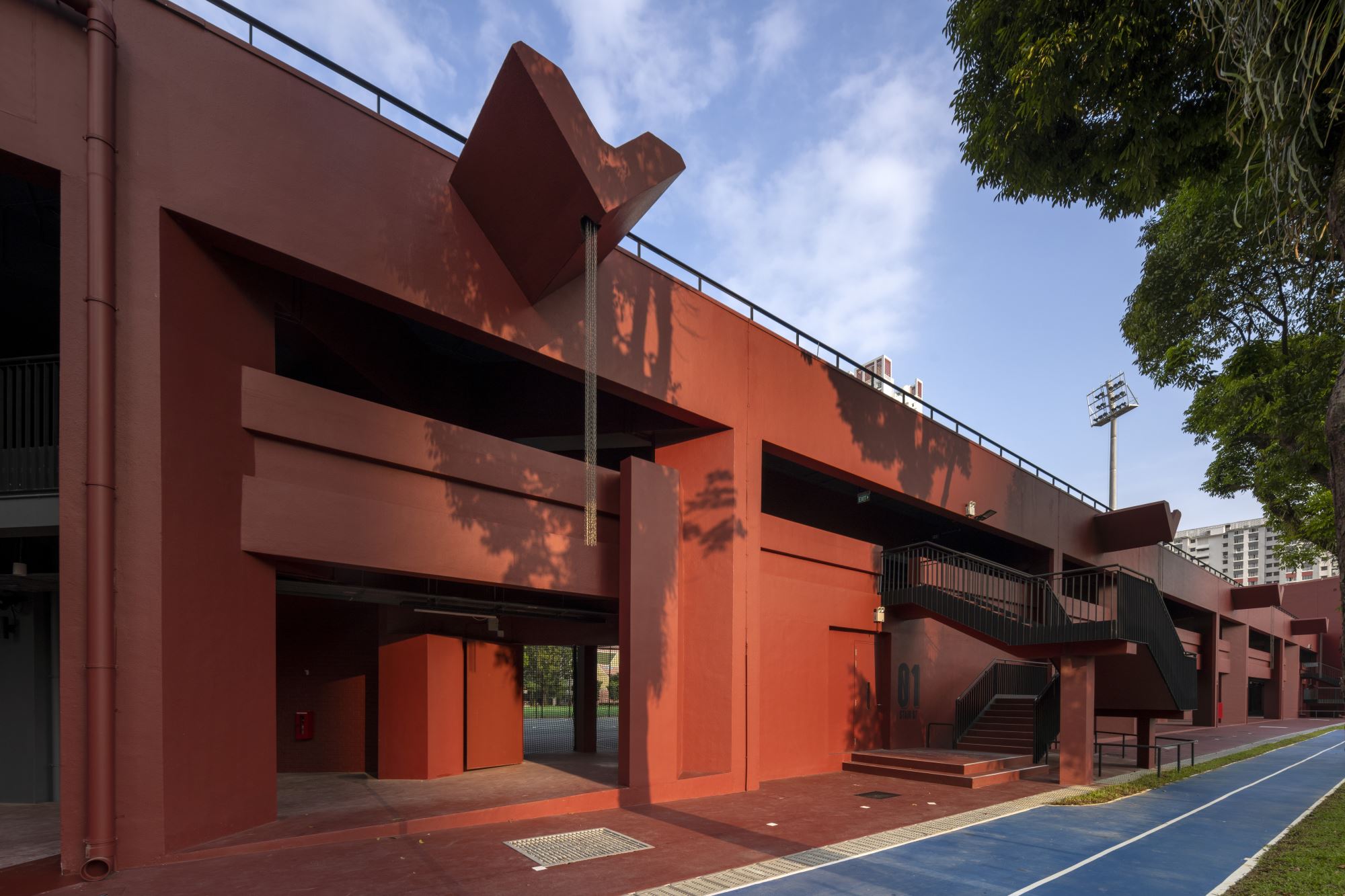
Elevated Promenade: The concrete stadium seating has been re-imagined as an elevated promenade that connects the swimming complex to the indoor hall horizontally, with integrated staircases along the pathway providing vertical connectivity, 2023.(Darren Soh)



 loading......