
Author
Lai Chee KIEN
Chee Kien is a lecturer and registered architect in Singapore, researching histories of art, architecture, settlements, urbanism and landscapes in Southeast Asia. He graduated from the National University of Singapore with an M Arch. by Research (1996), and a PhD in History of Architecture & Urban Design from the University of California, Berkeley (2005). His publications include Building Merdeka: Independence Architecture in Kuala Lumpur (2007), Building Memories: People, Architecture, Independence (2016) [awarded Book of the Year (2017)], The Merdeka Interviews (2018), and Cords to Histories: Architecture and Life in Southeast Asia (2021, in Chinese as 《歷史的臍帶:東南亞建築與生活》) [One of Asia Magazine's Best Ten Non-Fiction Books (2021)].
Visual representations of Singapore have consistently used a stylized lion symbol, in whole or in part, since the country attained self-governance. This is due to the city-state's name as well as the moniker "Lion City" that is derived from the Sanskrit words "singa" (lion) and "pura" (city) dating from the 13th century. "Singapura" replaced its prior place name of "Temasek" as the one that endured. The retinue of an ancient prince purportedly spotted a creature on the island that the prince proclaimed as a "singa," an auspicious symbol. Lions are not endemic to the region where Singapore was biogeographically located.
Most tourists and even locals identify with the Merlion as a symbol for Singapore in the present day. This was not always the case, as an earlier lion symbol was in circulation before the Independence of Singapore and its use persisted for as long as two decades after 1965. This essay discusses some design aspects of the Merlion, before attempting to delineate the forgotten design history of the lion that frst appeared in 1959.
Mr. Lim Nang Seng, a sculptor who had made Singapore his home, designed the Merlion sculpture at Singapore's seafront in 1972. From several sources including interviews with Lim, the present form of the Merlion was undoubtedly created by him, but he had adapted it from an earlier design drawn by Mr. Kwan Sai Kheong, when it was introduced to the public as the logo of the Singapore Tourism Promotion Board in 1964.
For the 1964 version, the then spokesman for the board explained that the root word of Temasek was "tasek" ("sea" in Javanese), and thus "in view of the change of name from Temasek to Singapura in ancient times, the emblem of a lion with a fsh tail emerging from the sea would not be an inappropriate emblem with which to perpetuate the Malay legend concerning the foundation of Singapore."
Lim studied the logo and determined that key changes were needed if it were to assume three-dimensional form. The banner at mid-tail bearing the words "Lion City" would need to go. More importantly, the logo creature had a "tail like a sandworm's" that did not make anatomical sense, nor could it be constructed as a top-heavy but freestanding sculpture. He revised his design countless times so that it could be better read as an entity, which was structurally sound, and fastidiously worked out details right down to the number and arrangement of body scales.
When asked if the work should be duplicated elsewhere after it was completed, Lim replied that there was no need and it would be meaningless, as "this is not a representative symbol of Singapore, but merely for tourism purposes." Notwithstanding, there are now facsimiles of the Merlion sculpture on the island itself, as well as in other countries like Indonesia and Japan.
The frst lion creature to represent a self-governing Singapore was introduced in 1959 at the Singapore Constitution Exposition. Staged along the former Kallang Airport runway, it was the primary event celebrating the country's attainment of self-governance. The overall architects for the exposition were Mr. Ang Kheng Leng and Mr. Ng Keng Siang, with Mr. Linky Lim as design consultant. Mr. Ho Pak Toe designed the exposition gateways, while Lim designed the notable fountain located just after the landside entrance. Along with government pavilions to showcase state functions, there were also booths of over 450 local and foreign trade and industry exhibitors, a stage for performances, and an amusement ground.
The frst lion creature to represent a self-governing Singapore was introduced in 1959 at the Singapore Constitution Exposition. Staged along the former Kallang Airport runway, it was the primary event celebrating the country's attainment of self-governance. The overall architects for the exposition were Mr. Ang Kheng Leng and Mr. Ng Keng Siang, with Mr. Linky Lim as design consultant. Mr. Ho Pak Toe designed the exposition gateways, while Lim designed the notable fountain located just after the landside entrance. Along with government pavilions to showcase state functions, there were also booths of over 450 local and foreign trade and industry exhibitors, a stage for performances, and an amusement ground.
The Constitution Pavilion was constructed at the city-facing entrance located near the confuence of the Kallang River, at the other end of the runway. The pavilion with a decodon plan was surmounted by a ten-foot high lion fgure made by Mr. Kwan Sai Kheong, then deputy principal of the Teachers' Training College, based on a picture furnished by Raffes Museum director Dr. Carl Gibson-Hill. It was described as follows:
"In the centre of its courtyard will be a special pavilion to illustrate the new constitution. It will be surmounted by a Statue of the newly discovered "Singa" of the original Singapura of the 12th to the 14th century. It will rise to a height of 60 feet dominating the view of the Exposition from the sea-ward site."
The possible provenance of the symbol in the archipelago was signifcant because of its historical Hindu-Buddhist associations in Southeast Asia. Eminent archeologist Dr. John Miksic is of the opinion that the Singa image was probably inspired by stone lion statues from the East Javanese period, although the lower part of the design was not an accurate depiction of statues known to him and probably created by the artist. The shorter mane of the Asiatic lion, which such stylised forms referenced, differing from the longer- maned ones on imperial British insignia.
The connection between Singa and the island was reinforced with the gift of a gold-plated paperweight presented by the then Chief Minister Lim Yew Hock to the visiting Prince Philip in February 1959. The paperweight featured a gilded Singa, "the Lion of Singapore," affxed to a base shaped as a map of Singapore. The gift from "the Government and people of Singapore" to the Queen's representative encrypted additional meanings that the former colony now had its own symbol, against the British lion symbol used on prior colonial insignia. Stamp labels bearing Singa on a Singapore map were later used to remind citizens to vote in the legislative assembly elections on 30 May the same year.
The Constitution Pavilion at the exposition showcased how self- governance was achieved after a series of Merdeka talks in London. There was also a voter register placed inside it for the public to peruse, in preparation for frst election where voting was compulsory. Between the time of the exposition and the elections, Singa made appearances on almost all election paraphernalia including posters, brochures, and the stamp label mentioned above. In one "Our Duty to Vote" brochure encouraging eligible Singaporeans to participate, Singa was portrayed as casting a vote with its right paw into a graphic ballot box. This depiction associated Singa directly with the identity of a Singapore citizen.
A set of six stamps was issued on 1 June, two days after the legislative assembly elections, to celebrate the new constitution and self-governance status. The stamps bore exact designs except for the background hue and denomination (4, 10, 20, 25, 30 and 50 cents). Described as "Her Majesty and the Singapore Lion against the Administrative Centre," each stamp featured a golden Singa at the bottom left corner of the stamp, and a much smaller portrait of Queen Elizabeth at the top right. It was the only instance that colonial and self-governance symbols appeared together on Singapore stamps.
The expression on Singa's face, unlike the taciturn one used thus far by the Lim Yew Hock government, is a smile, if not seemingly breaking out into a chuckle. Because the two faces are at the same height and facing each other, it might be read that Singa is communicating that chuckle to Elizabeth. The background depicts a grainy worm eye's view across the length of the Padang, with the tower of the Victoria Memorial Hall as the slightly off-centre perspective point in the distance. On the left side, the Esplanade is obscured by Singa, but the old Supreme Court and City Hall can be made out on the right. There is a possibility that an architect drew this background image. In a conversation with Dr. John Seow, son of the late Dr. Seow Eu Jin, he disclosed that he remembered his father submitting a larger sketch of that scene upon a public solicitation for design entries for a new set of stamps in the newspapers.
The stamps were issued on 1 June 1959, but in the meantime, the government that commissioned them had been replaced by another. The photogravure and printing were made by security printers Harrison and Sons in London. Mr. Koh Seow Chuan, an avid collector and president of the Singapore Stamp Club from 1967 to 1976, estimated that the printing and delivery processes during that era would usually take 12 to 18 months. This suggested that the prior government had expedited the two processes from the time the Singa symbol was designed.
The offcial First Day Cover envelope for this set of stamps has words and images on its left edge. Under the phrase "First Day Cover" are printed: "In Celebration of the New State of Singapore." Further below, a left-facing Singa is portrayed within a blue vignette, and over a brown pointed chevron with one of its tips underlapping a photographic image of the Legislative Assembly Building (now the Art House).
These stamps were in circulation for a year before the next issue of two defnitive stamps on 3 June 1960, whose common design was a fapping fag of the new state. The design of the fag was passed in the legislative assembly on 11 November 1959, along with the confrmation of the National Anthem and the State Crest design that introduced another lion and a tiger astride a shield.
There was an "afterlife" of the Singa from the 1959 stamps. On 9 August 1984, the 1959 stamp designs with Singa and the Padang area were reused again on a new set of six stamps with the same background tints and Singa design as that of the 1959 ones, but the background extended upwards to create a larger stamp surface. The denominations of the new stamps had increased to a range between 10 cents to 2 dollars.
A previously-issued stamp from the post-Independence era was designed at the top right corner and replaced the Elizabeth portrait, i.e., a stamp placed within another stamp. Respectively, the miniature "second" stamp featured National Service, sport, public housing, wayside trees, Changi Airport, and the Monetary Authority of Singapore. Singa was now "pleased" with the progress of aspects and achievements encapsulated by the added stamps. The Singa fgure made a fnal appearance on a set of 1992 stamps themed "Currency Notes and Coins," but this time as an image engraved on a coin.
The frst set of Singapore coins was circulated on 20 November 1967, two years after Independence. It featured six coins of different denominations ranging from one cent to one dollar. The designs on the reverse sides were imprinted the release year, the word "SINGAPORE," the coin value, and two graphic stalks of rice paddy. The obverse sides of the fve- to ffty-cent coins depicted different marine-related creatures, while the one-dollar coin featured a lion. These coins were minted annually until another set replaced them in 1985.
Stuart Devlin, the engraver of these coins, had only ever claimed the fve-cent (snakebird) and ffty-cent (lionfsh) coin designs as his own work. In an interview, Lim Nang Seng, who would subsequently design the Merlion, spoke at length about his design of the one-cent coin (a block of fats alongside the Hong Lim Park fountain) as well as a set of sketches he had submitted to the coin design committee that included a seagull, seahorse and swordfsh, which he believed were subsequently redrawn for engraving. The ten-cent coin featured the seahorse and the twenty-cent coin, the swordfsh. It can not yet be ascertained who was responsible for a lion fgure to adorn the obverse side of the one dollar coin in that set, but it was likely decided by the committee members as it was the largest coin and of largest value.
Though never offcially described as Singa, the lion engraved on the earliest Singapore one-dollar coin bears remarkable similarity to that used on the 1959 stamp designs. For the Expo '70 in Osaka, the frst convened in Asia, a set of commemorative coins was one of the Singapore Pavilion's souvenirs. The dollar coin in that set was described as designed "based on a Singapore lion symbol fanked by stalks of paddy." In subsequent commemorative sets minted up to the year 1984, it was described as a "stylised lion."
In 2013, a third series of coins was minted for circulation in Singapore. The Merlion is now engraved onto the obverse side of the one-dollar coin, seemingly suggesting a fnal replacement of Singa from the frst series, as the second series from 1985 featured plant designs. There is an additional lion-head outline at the top rim of all third series coins but both it and the Merlion sport long manes like prior colonial symbols.
There was a representative lion symbol for Singapore in public circulation from 1959 to 1985. In its various uses, Singa the lion was graphically linked with the island, as well as depicted as a citizen with voting rights. Its origins in the Hindu-Buddhist pictorial system associated it with the region besides it being a protagonist in the founding myth of Singapore. More importantly, it was used post-colonially as a different "local" identity to counter prior colonial uses of the lion symbol, which was of a different sub- species. In my view, Singa was a more deserving symbol for Singapore than the Merlion, and it should not be forgotten.
Figures
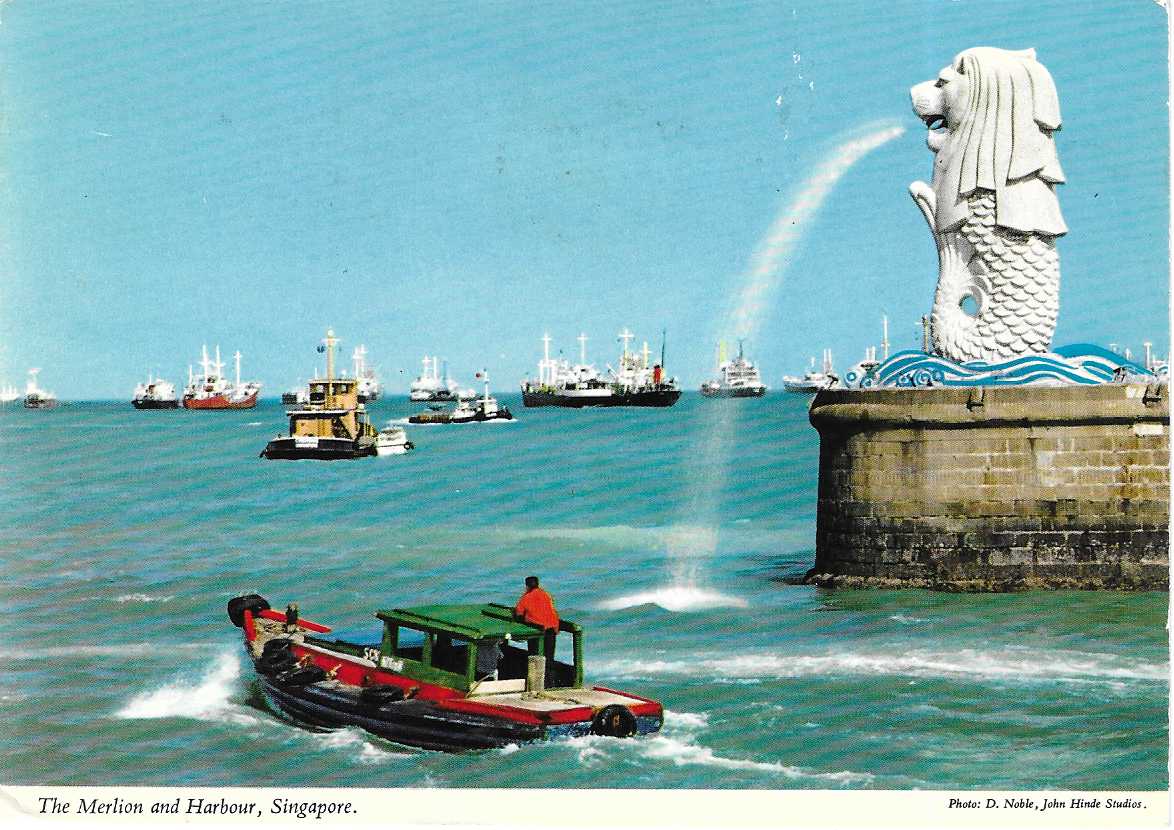
The Merlion at its former location at the mouth of the Singapore River.
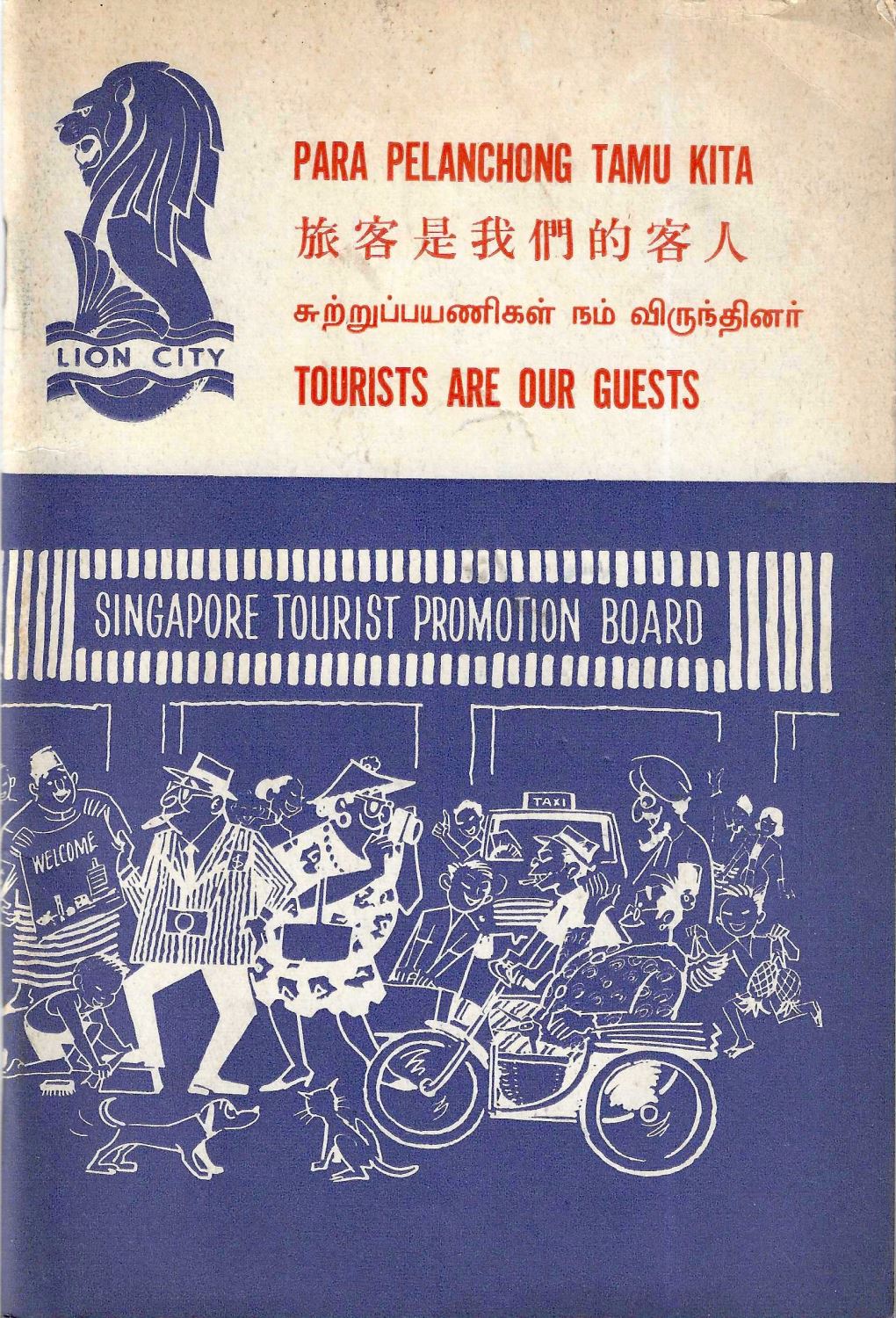
The original logo for the Singapore Tourism Promotion Board at top left of this brochure.
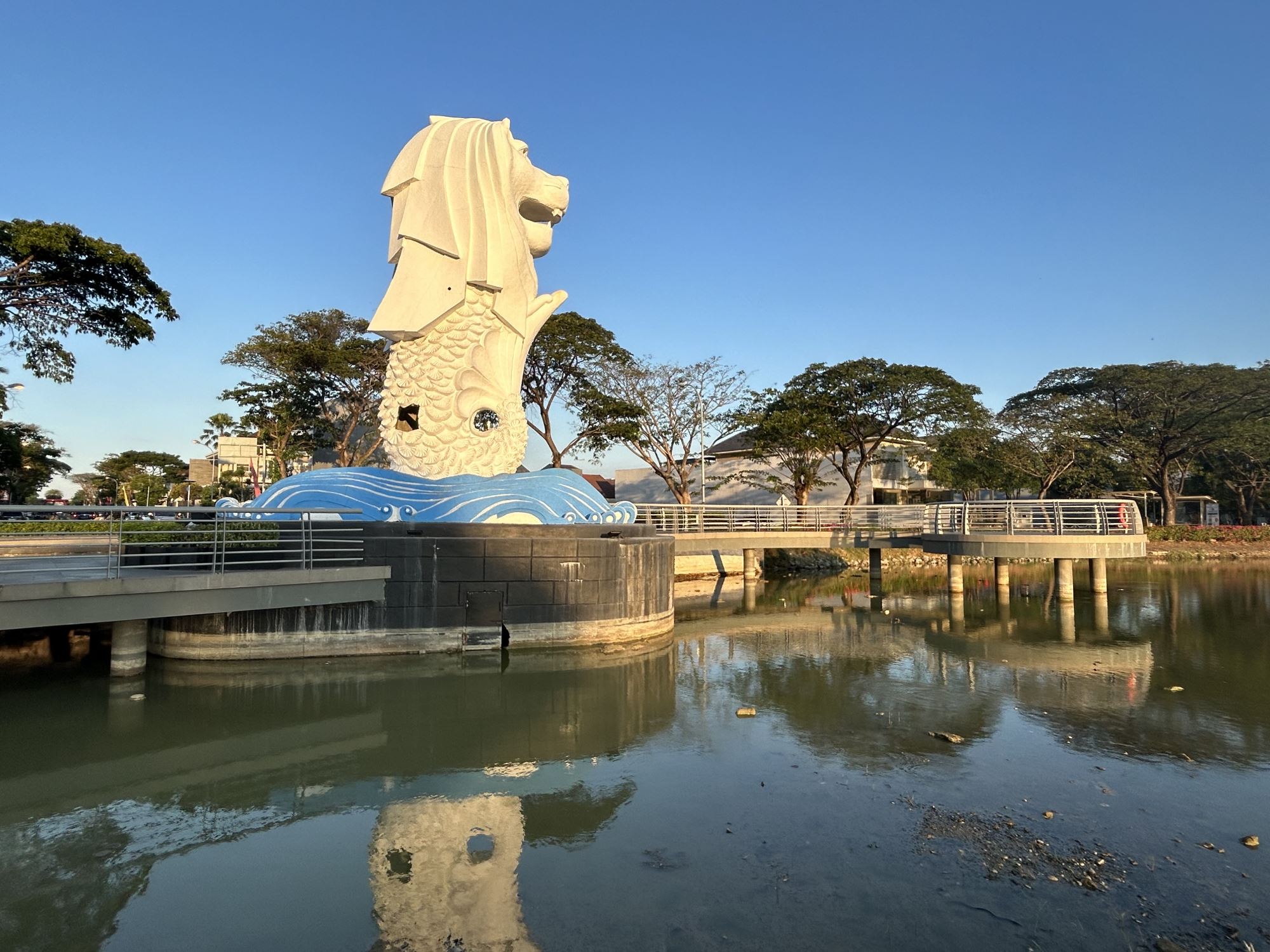
The Merlion at Citraland, Surabaya, Indonesia.

Sketch of the Singapore Constitution Exposition by Ang Kheng Leng and Ng Keng Siang
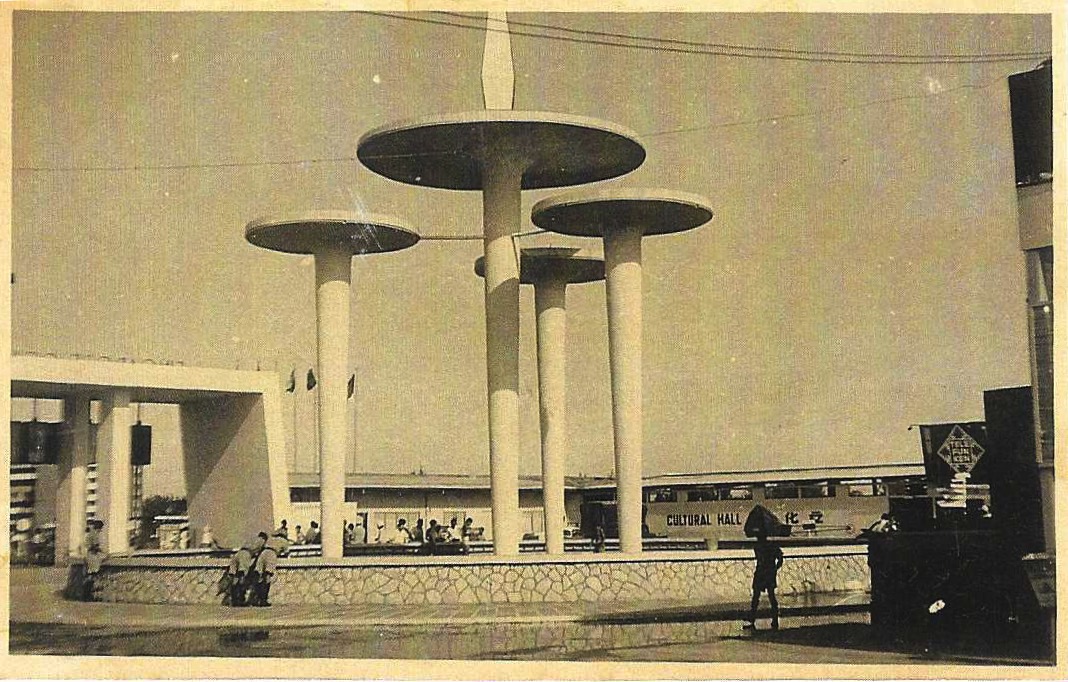
Fountain just after the Kallang side entrance to the exposition, designed by Linky Lim.
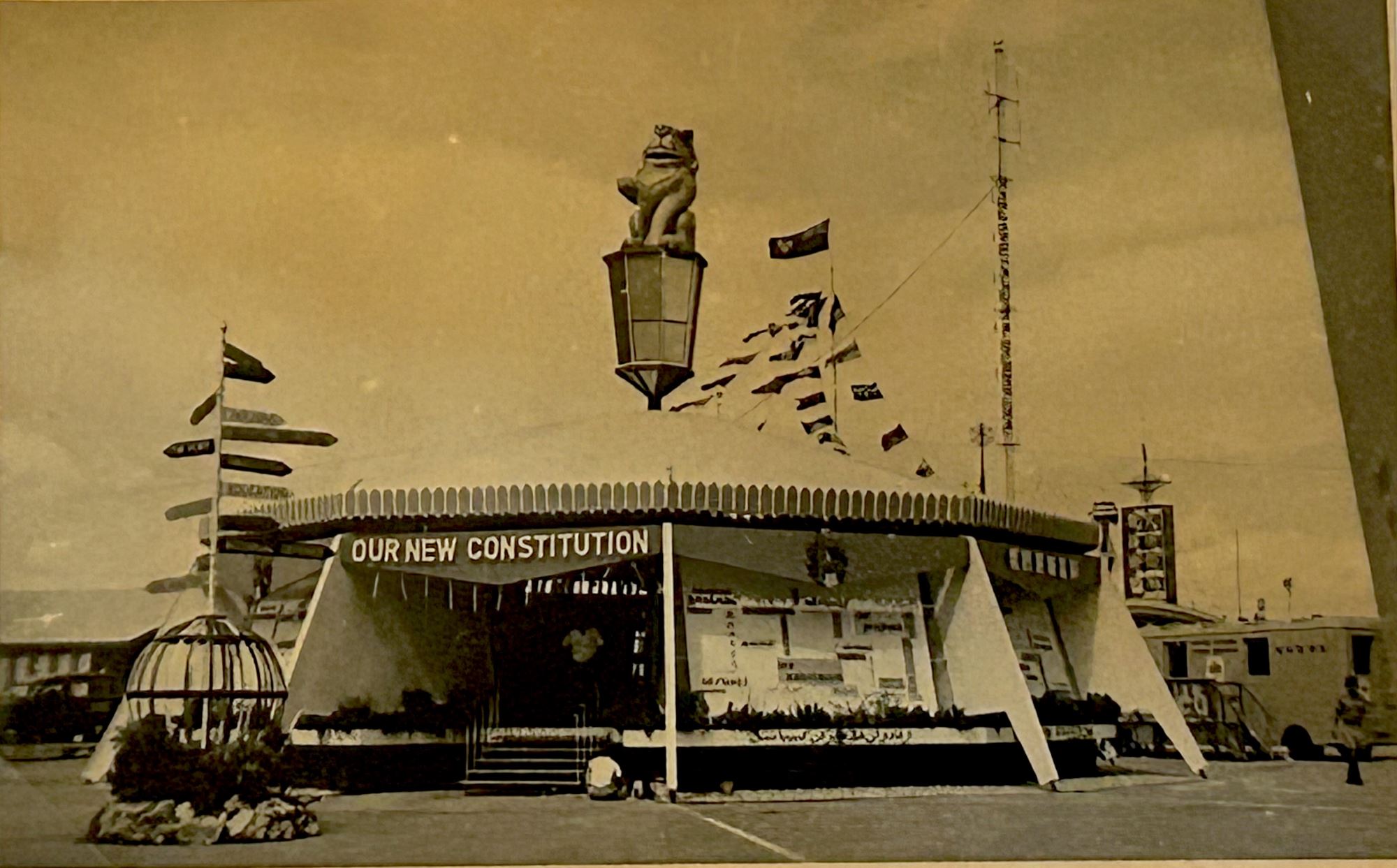
The Constitution Pavilion at the seaward entrance, surmounted by the Singapore statue.
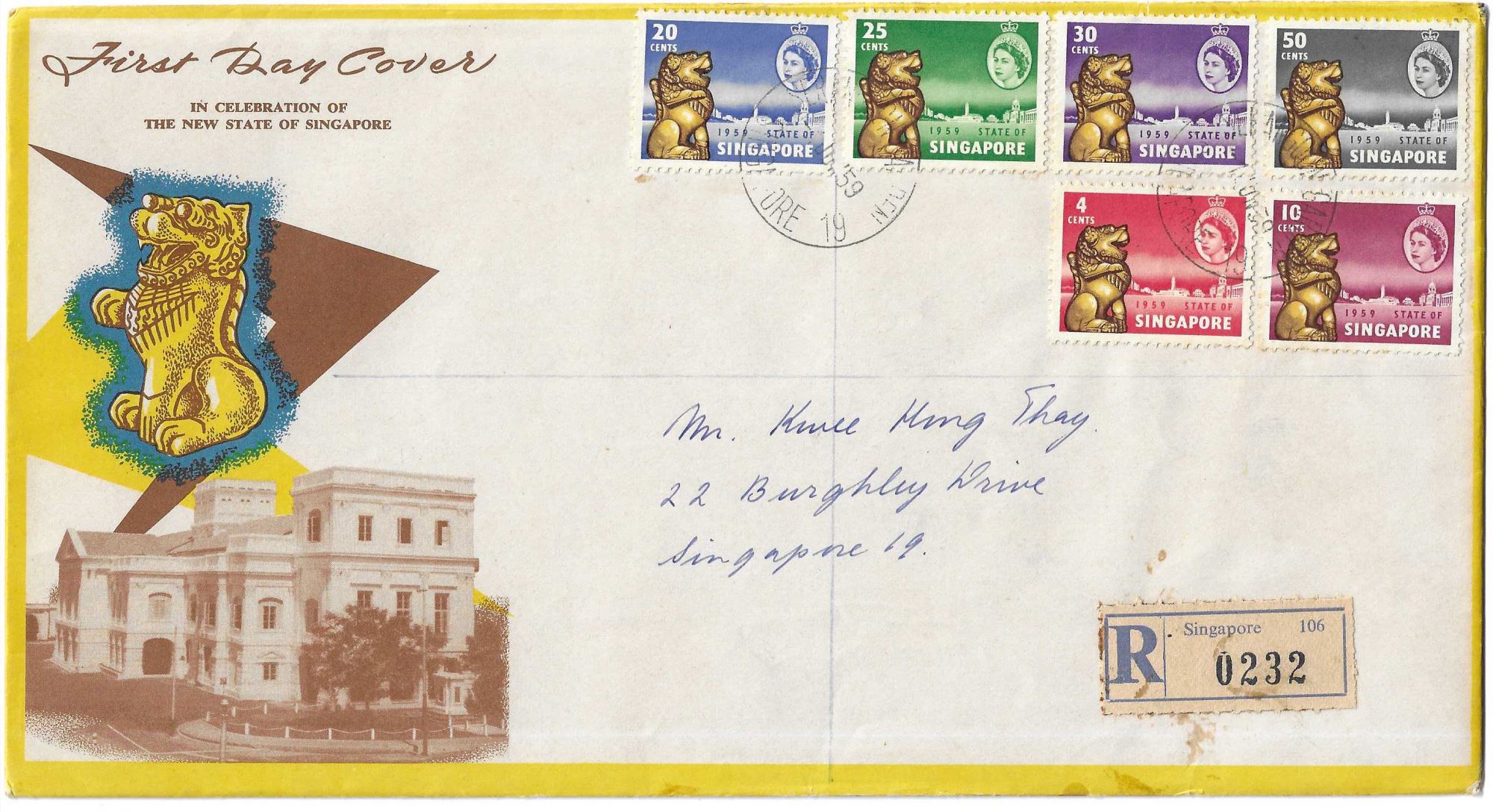
First Day Cover issued on 1 June 1959.
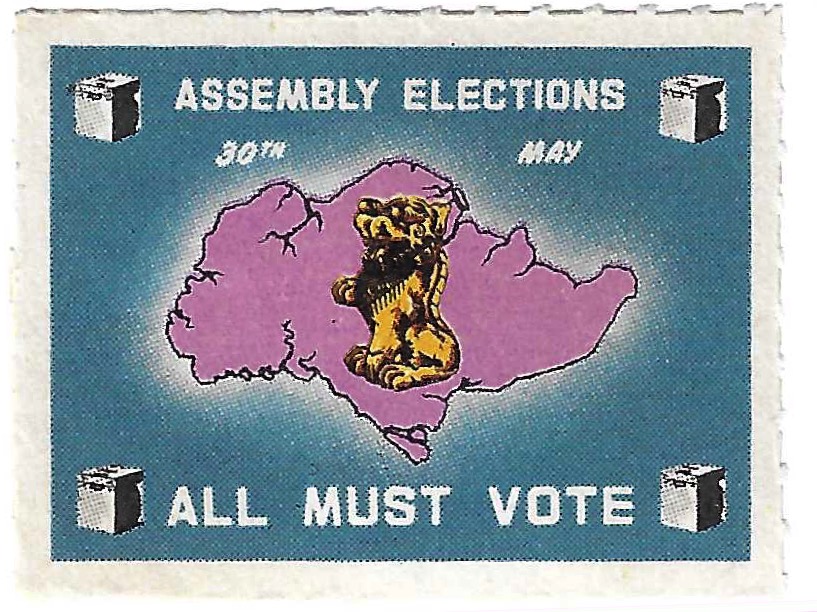
Election sticker for the 1959 Legislative Assembly elections.

The voting Singa.
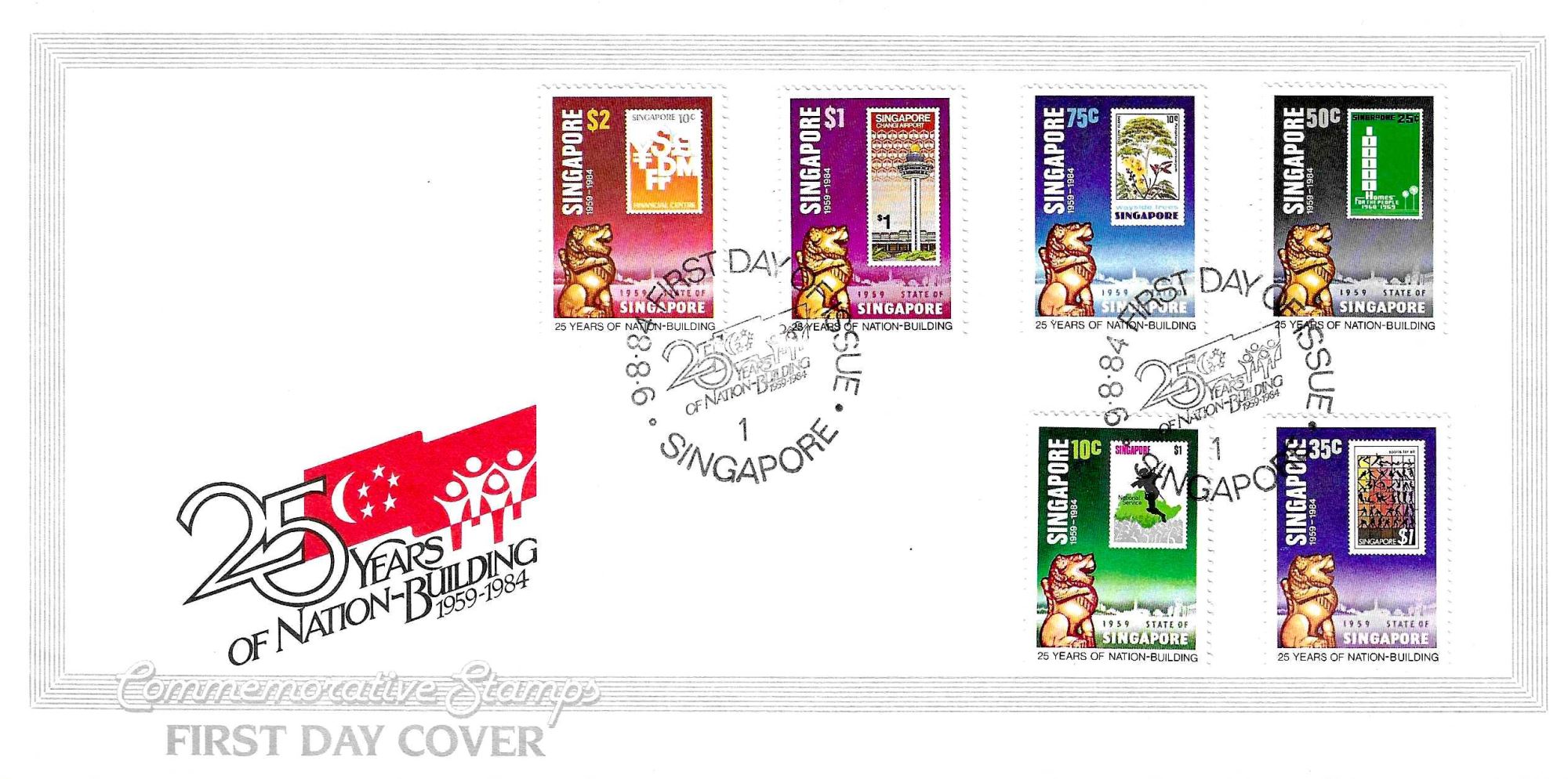
First Day Cover issued in 1984.



 loading......